
Hello, all, and welcome back! I apologize for yet another long gap in posting, but life has been hectic as always. I recently began a job working for a metro Atlanta Animal Control facility, and if you know anything about the Georgia Shelter crisis, I feel like that explains enough why I have not had the time to sit down and write.
However, my schedule is finally evening out, so today I would like to cover something incredibly important.
Has your dog ever snapped at you or another dog over their food? Maybe some treats? How about their favorite toy? Maybe they even growled at you for trying to take something they pulled from the trashcan?
That could be a strong sign your dog has resource guarding problems.
But, what is resource guarding?
I prefer the National Institutes of Health’s definition, which is as follows:
“Resource guarding is a behavior motivated by the defense of valuable resources, as perceived by the dog.” – National Institutes of Health
In English, it is a behavior shown to discourage another animal (humans included) from taking belongings/invading space.
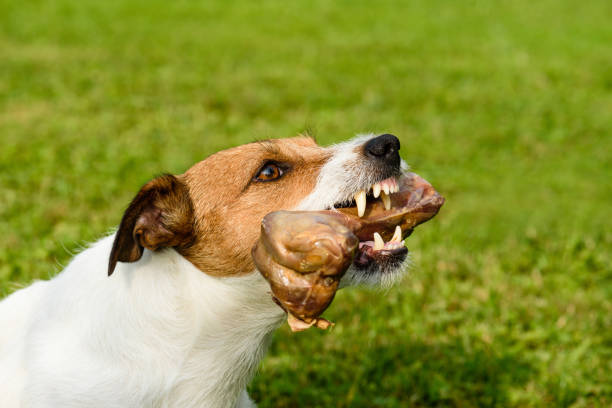
These valuable resources can be toys, bowls, food, treats, blankets, beds, and can even go as far as their favorite people. With resource guarding, your dog views people/other animals approaching their belongings as a negative thing. This is because they are afraid of someone taking their things.
I often see this behavior in animal control facilities, due to the feeding procedure and usual overcrowding of my local and statewide facilities. Due to the fact that there are so many dogs, many animal controls give them their chance to eat, and remove the bowl/discard the food during kennel cleaning regardless of whether or not they have eaten it.
What does resource guarding look like?
Every dog will exhibit different signs based on their level of fear. In situations like this, it is important to understand and remember that most canine aggression is rooted in fear.
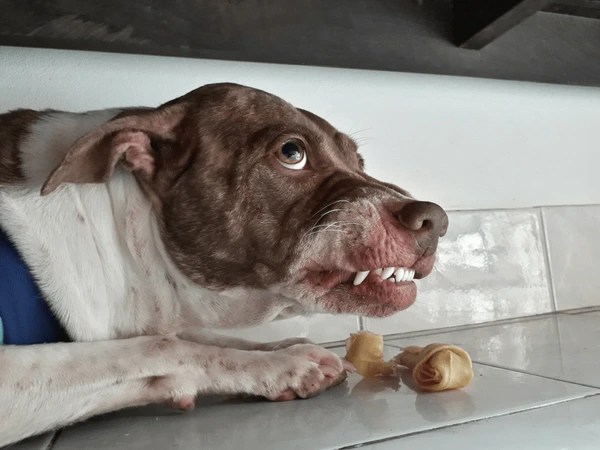
Some dogs may growl, lick their lips, and whale eye (eyes so wide they are showing the whites.) Others may bark, lunge, and attempt to bite.
While this behavior can be quite intimidating, and may make you look down on yourself as a dog parent, it is crucial to remember this is normal dog behavior. It is also important to note this is the most simple instance of aggressive behavior to modify (luckily.)
What causes resource guarding behaviors?
Resource guarding behaviors, and most types of aggression, are due to a lack of confidence and/or anxiety. Many people still prefer to tout the “pack mentality” myth which explains resource guarding as an attempt to gain status in their pack.
However, this is obviously not the case as I don’t believe Mr. Toodles the hypothetical dog is worried about his status in the house. He knows he rules the roost.
Think of a confident, stable dog. They typically do not feel the need to carry around their bone, or constantly fight anyone who attempts to touch it. A confident and stable dog will leave their valued items around the house and allow others to pick them up/touch them. They do not worry someone is going to steal from them.
On the other hand, an anxious dog will worry about being stolen from. They will worry about their favorite toy, or having enough to eat. As I mentioned before, this is why resource guarding is seen so much in shelters, as well as pets recently adopted from that environment.
In a shelter environment, animals are often given a short amount of time to eat before kennels need to be cleaned and staff needs to go home. The bowls are usually taken up very quickly regardless of whether or not the animal ate.
This is done in an attempt to avoid later issues also related to resource guarding. There is potential for a dog who also suffers from the same fear based behaviors to act aggressively towards kennel staff if they attempt to take them out of the kennel while they are guarding an old food bowl.
While this is safe thinking, it unfortunately still has the potential to create the same behaviors we work to avoid and can cause them for future adopters.

How do you work on these behaviors?
First and foremost, resource guarding is not a problem which can be solved by punishment or corrections. If you correct a dog who suffers from these behaviors, you are only solidifying their fear that you are a threat.
These big, scary behaviors are attempts to communicate with you. Therefore, it is also important not to discourage your dog from growling. Now, I know that sounds weird because people think it is rude for Mr. Toodles the hypothetical dog to growl, but again, this is a form of communication. This is NOT a form of aggression, but a way for your dog avoid exhibiting aggressive behaviors. Discouraging your dog from growling makes it more likely they will bite without warning, and no one wants that.
To ensure this training is thoroughly effective and avoid any unfortunate situations, it is important that your dog stays under threshold. Essentially, you want to back off before your dog feels any reason to react to what you are doing.
Signs your dog may be going over threshold can include:
-Eating faster (if approaching the dog’s bowl while eating)
-Freezing up
-Stiffening of body/muscles/tail
Now that the basics are covered, I want to go over two types of resource guarding behavior and how to work on them.
Food Aggression
The first step to work on food aggression is no free feeding. When your dog is free fed, they are not associating you with their food. They just see a bowl that is always full of food somehow. They need to learn that food comes from people, not the food fairy who keeps their bowl full.
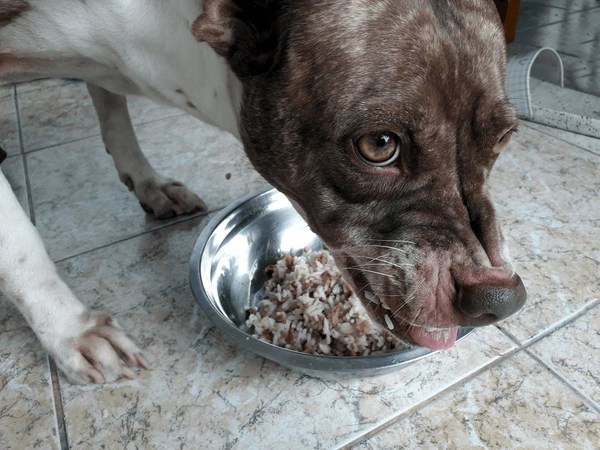
The Refill exercise is also a great way to work on food aggression.
For this exercise, you will need to measure out a meal’s worth of kibble, and put that into a training pouch or other container that is out of the reach of your dog. You will then place an empty food bowl on the floor for your dog.
If you believe there is potential for your dog to act out and attempt to bite, I recommend putting up a baby gate or some other barrier between yourself and the dog.
To complete a rep of this exercise, approach the bowl, add a few pieces of food and then step back roughly 6-8 feet. Wait for him to finish eating, then repeat until you run into any of the following:
-The dog begins to respond positively to you approaching the bowl (tail wagging, calm eyes, not tense.)
-The dog loses interest in eating
-You run out of kibble
If you ran out of kibble, repeat this exercise in the next session you do.
If your dog reacted positively (3 reps completed with no reactivity/aggression and full comfort) you may continue to phase two.
This time around, add something of higher value, such as shredded chicken or some canned food. You want to add a few pieces of kibble along with 1-2 pieces of the high value item.
Similarly to phase one, you are looking for 3 reps with positive reactions and body language before moving on.
In phase 3, you will fill your dog’s bowl with roughly 1/4 of what you would normally feed in a meal. Present this to your dog, and attempt to approach as he eats. Upon approaching, toss a bit of the higher value item into the bowl (or near it, for those like me who throw with poor aim.)
You want to ensure that you are staying far enough that your dog shows no warning signs.
Repeat until 3 reps with the same requirements as the last 2 phases.
Remember, if at any point your dog begins to show signs of stress or exhibit aggressive behaviors to lower the intensity of the exercises.
This can be done by adding more distance between your dog and yourself, or going back a phase in the process.
Object Guarding
If your furry friend only likes to guard objects (such as toys, bones, or a ball) and not their meals, I would still recommend doing the exercise I explained above. This particular exercise can help to build a strong, trusting foundation between you and your dog that will help with reaching the overall goal.
For dogs with object guarding issues, I recommend the treat toss game.
Set up a situation where your dog will guard an object. This could be taking them to their bed, or putting them on their spot on the couch. You want to then give them an object they can enjoy safely, such as a pig ear or bone.
Walk away from your dog, and then come back. Remember to stop at a distance that does not provoke any kind of reaction, we want to keep them under threshold. Then toss a piece of chicken/beef liver/ or other extremely high value item near them. Walk away, return, and repeat 5-6 times before ending that session.
Each time you do this exercise with your dog, gradually shorten the distance between you and them. However, remember that you want to see a positive physical response from your dog before doing so. The idea is to steadily shift your dog’s thinking from, “hey, someone is approaching, they make take my things,” to “hey, someone is approaching, they have something better for me than my bone!”
Eventually, you can broaden this by tossing your dog a treat any time they are chewing on a toy or bone.
Drop it
When it comes to object based resource guarding, teaching your dog the “drop” or “give” command can be incredibly useful.
To teach this command, give your dog a toy that they do not find particularly high in value. Approach and present them with a higher value reward.
When your dog releases the toy, give the command “drop” or “give” and give them the reward.
Start with short sessions, no more than 2-4 reps at a time to prevent your dog from getting frustrated. Over time, you can work your way up to longer sessions.

When is it time to seek help from a professional trainer?
You have been working on your dog’s training for weeks, taking everything slow, but now your dog has bitten you and it doesn’t seem to be getting better. What do you do?
Sometimes, as pet parents, you may need to reach out to a professional trainer experienced in behavior modification, or even a behaviorist.
Signs it may be time to consult a professional include:
-several weeks of training completed with little/no improvement
-if your dog has bitten someone, or you are seriously concerned they may
-if you have young children in the home
-if you are at all uncomfortable with or uncertain about completing the training outlined above by yourself
Thank you for joining me again, I hope this post can provide not only some insight into your dog’s behavior, but some reassurance to all the anxious pet parents out there. Your dog, and you, can get through this as long as we remember to work as a team with our fur kids.
Have a lovely, morning, afternoon, and evening… oh, and pet your dog for me.
 The Dog Trainer's Den
Leave a comment